Cases
Standardized heat stress analyses for Amsterdam
Cases
Standardized heat stress analyses for Amsterdam

Heat stress is a growing challenge for Amsterdam, requiring evidence-based policy and standardized analyses. Discover how Amsterdam Engineering Office (Ingenieursbureau Amsterdam) uses the Tygron heat stress module to map the capital and make it future-proof.
Customer
Municipality of Amsterdam
Themes
Climate
Urban Development
Services
Tailor-made training
Licenses
Challenge
The structural challenge of urban heat
Heat in the city is a structural challenge and demands a policy adjustment. Clara Keuken and Tom Remijn, water & climate adaptation advisors at the Amsterdam Engineering Bureau (Ingenieursbureau Amsterdam), explained at the Tygron user day of October 2025 how they tackle heat stress analyses in the capital. “We expect more and more heat policy, because that is lagging slightly behind water policy,” Remijn explains. “That is why we are now looking at where we can standardize our work, as well as make it faster and less prone to errors, so that we can respond to that increasing demand.”
The policy is not yet law, but there is an agreement of intent with the metropolitan region (Metropoolregio Amsterdam). Two rules are central: every Amsterdam resident must have a cool spot within three hundred meters (at least 200m² of shade and a perceived temperature below 35 degrees) and there must be forty percent shade on walking and cycling routes. “That is the so-called slipper distance,” says Remijn. “No official policy means we have no stick to beat anyone with, but especially in large-scale projects, everyone is very willing to cooperate on this.”
Challenge
The structural challenge of urban heat
Heat in the city is a structural challenge and demands a policy adjustment. Clara Keuken and Tom Remijn, water & climate adaptation advisors at the Amsterdam Engineering Bureau (Ingenieursbureau Amsterdam), explained at the Tygron user day of October 2025 how they tackle heat stress analyses in the capital. “We expect more and more heat policy, because that is lagging slightly behind water policy,” Remijn explains. “That is why we are now looking at where we can standardize our work, as well as make it faster and less prone to errors, so that we can respond to that increasing demand.”
The policy is not yet law, but there is an agreement of intent with the metropolitan region (Metropoolregio Amsterdam). Two rules are central: every Amsterdam resident must have a cool spot within three hundred meters (at least 200m² of shade and a perceived temperature below 35 degrees) and there must be forty percent shade on walking and cycling routes. “That is the so-called slipper distance,” says Remijn. “No official policy means we have no stick to beat anyone with, but especially in large-scale projects, everyone is very willing to cooperate on this.”
Approach
Automated workflow
Tygron is used for large-scale area developments, where design freedom and impact are significant. There was a need to automate the manual loading, unloading, and converting of data, which was quite prone to errors. The advisors found the solution in an FME script that automates the entire workflow. "The template manages the startup of Tygron, the calculations within the platform, and the unloading of all our Tygron maps that we want to use in one go," Clara Keuken explains. The input is minimal, only the project area, a password, and the storage location. The result is radically faster processing. The advantage of the new, fully automated approach is clear: "One click of the button and you can grab a coffee or read your email," says Keuken. Then, with a laugh: "But I prefer to get coffee."
Approach
Automated workflow
Tygron is used for large-scale area developments, where design freedom and impact are significant. There was a need to automate the manual loading, unloading, and converting of data, which was quite prone to errors. The advisors found the solution in an FME script that automates the entire workflow. "The template manages the startup of Tygron, the calculations within the platform, and the unloading of all our Tygron maps that we want to use in one go," Clara Keuken explains. The input is minimal, only the project area, a password, and the storage location. The result is radically faster processing. The advantage of the new, fully automated approach is clear: "One click of the button and you can grab a coffee or read your email," says Keuken. Then, with a laugh: "But I prefer to get coffee."
What has been modeled
Heat stress
Apparent temperature


Result
Buiksloterham: An old industrial area becomes a residential and working area
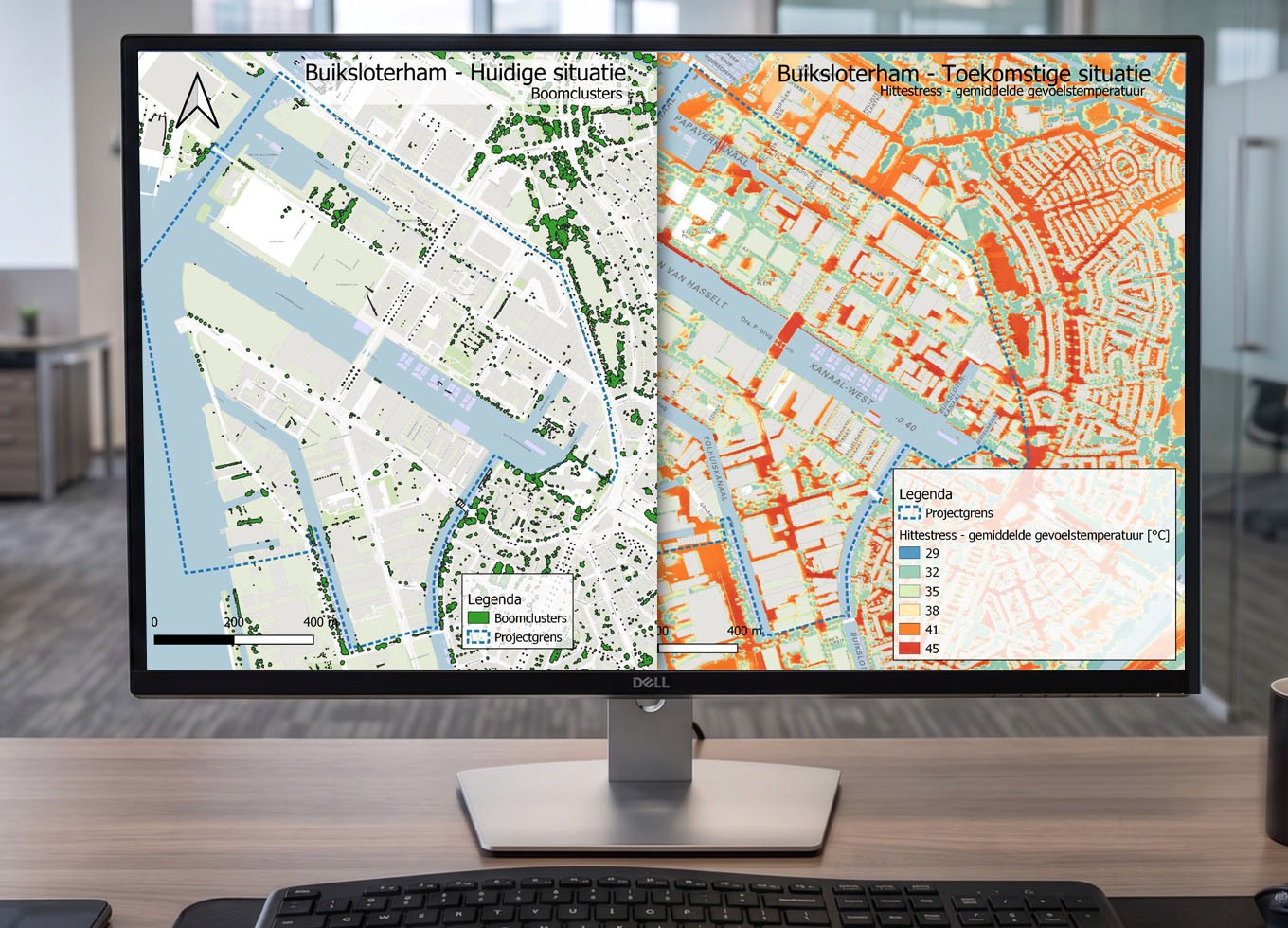
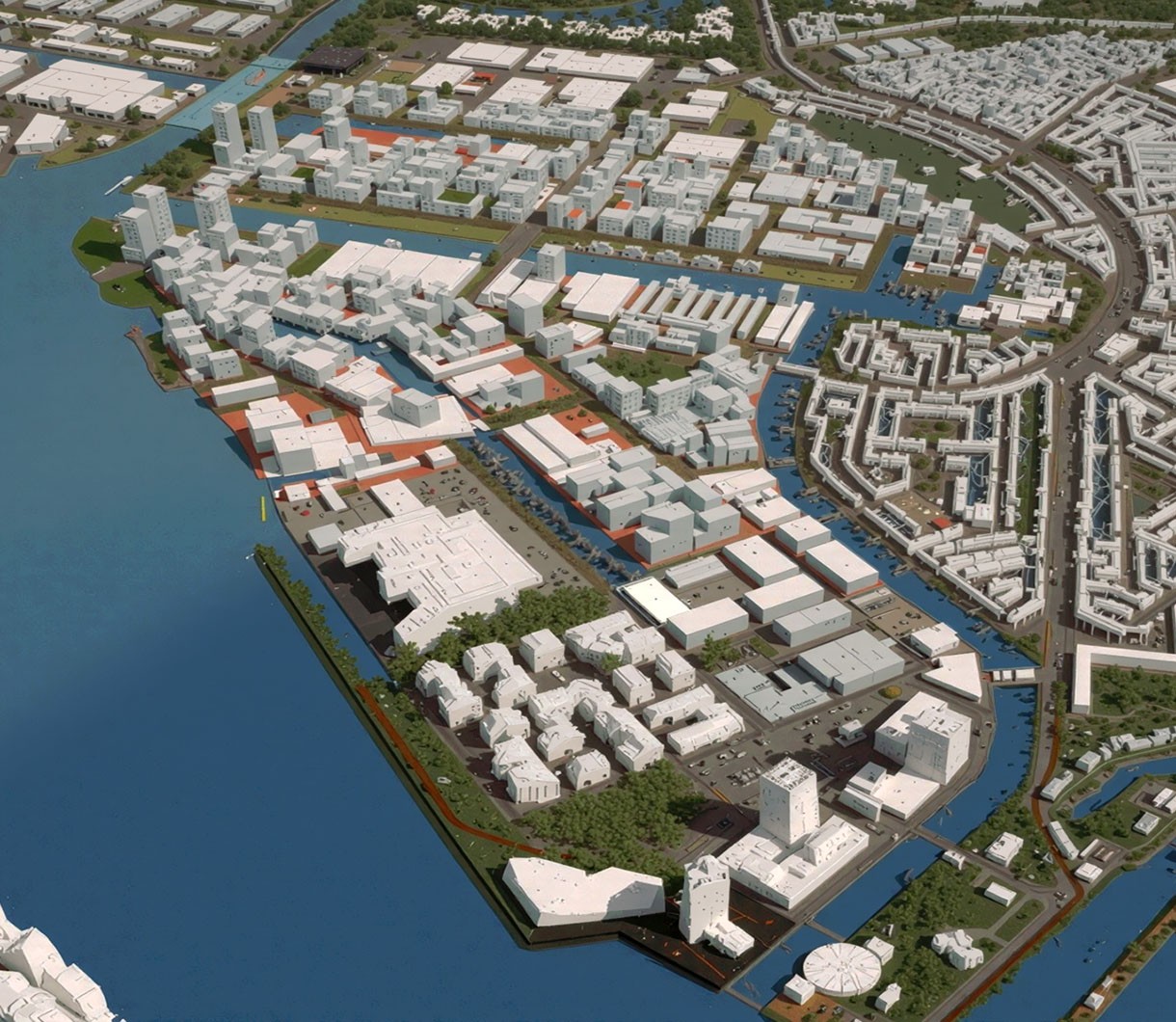
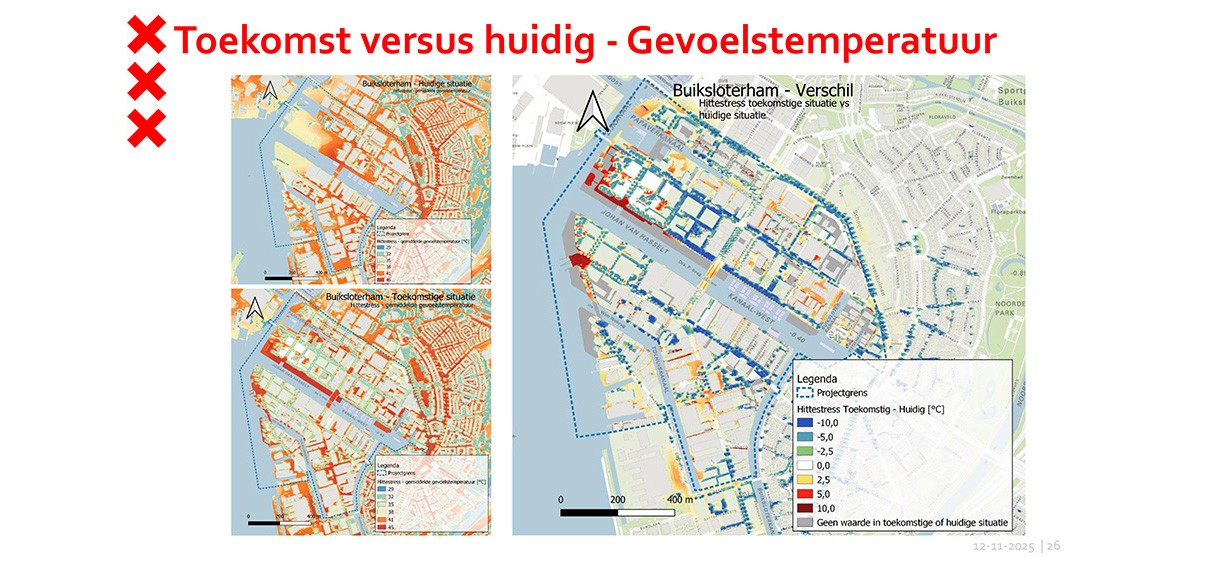
The approach has been applied in Buiksloterham. An old industrial estate is being turned into a residential-work area. The current situation has hardly any cool spots. In the new situation, extra trees will be planted, meaning coolness can be found within 300 meters almost throughout the entire area. Difference maps mercilessly expose the last warm spots, for example at the ferry landing. "A lot of time is spent there during the day," says Remijn, "so it is good that we now have that in our sights." Yet not everything has been solved.
For large new construction projects, it still takes hours to get designs Tygron-ready. "For us, there is often really hours of work involved," says Keuken, "to the point that sometimes it doesn't work out." The wish is that the delivery of data becomes standardized, also from designers, so that more time is left for actual advice. "So that we are less busy with those small tasks and we can calculate faster and spend more time together improving the design."
Result
Buiksloterham: An old industrial area becomes a residential and working area
The approach has been applied in Buiksloterham. An old industrial estate is being turned into a residential-work area. The current situation has hardly any cool spots. In the new situation, extra trees will be planted, meaning coolness can be found within 300 meters almost throughout the entire area. Difference maps mercilessly expose the last warm spots, for example at the ferry landing. "A lot of time is spent there during the day," says Remijn, "so it is good that we now have that in our sights." Yet not everything has been solved.
For large new construction projects, it still takes hours to get designs Tygron-ready. "For us, there is often really hours of work involved," says Keuken, "to the point that sometimes it doesn't work out." The wish is that the delivery of data becomes standardized, also from designers, so that more time is left for actual advice. "So that we are less busy with those small tasks and we can calculate faster and spend more time together improving the design."
"
“In one go, the template arranges the startup of Tygron, the calculations within the platform, and the exporting of all our Tygron maps that we want to use,"

Clara Kitchen
Municipality of Amsterdam
"
“In one go, the template arranges the startup of Tygron, the calculations within the platform, and the exporting of all our Tygron maps that we want to use,"
Clara Kitchen
Municipality of Amsterdam

